Why Our Extension Has No Blue-Light Filter
By Raphael Ben-Hamo, Digital Relief
6 min read · Published October 13, 2026
Reviewed against peer-reviewed research — our standards & sources
When we built Digital Relief, our Chrome extension for screen breaks, a blue-light filter was the most obvious feature to add. Many screen tools offer one.
We left it out on purpose. This post explains why, using the research we read before deciding.
What blue-light products promise
Blue-light products come in a few forms: glasses with filtering lenses, screen filters, and software "night modes" that make the display warmer in colour.
The claims around them vary. A 2023 Cochrane review summed up the main ones: that filtering lenses improve how well you see during screen use, protect the back of the eye, and help you sleep (Singh and colleagues, 2023).
For a break-reminder extension, the first claim is the one that matters. Would a filter make your eyes feel better during a long day at the screen?
What the reviews found for eye strain
Two systematic reviews looked at this question, and neither found good evidence that blue-light filtering helps.
The Cochrane review. Singh and colleagues gathered 17 randomised trials comparing blue-light filtering lenses with ordinary lenses. The trials were small, from 5 to 156 people, and short, from under a day to five weeks.
Their conclusion: filtering lenses may not reduce eye-strain symptoms with computer use over the short term, compared with ordinary lenses. They found no clinically meaningful difference in critical flicker-fusion frequency, a lab measure used as a sign of visual fatigue, and probably little or no effect on sharpness of vision.
The certainty of that evidence was low. Many of the trials had a high risk of bias. That cuts both ways: there's no solid proof that filters help, and the trials weren't strong enough to rule out a small effect.
The young screen users review. Mataftsi and colleagues reviewed what makes digital eye strain better or worse in people under 40 (Mataftsi and colleagues, 2023). They included 10 studies with 2,365 participants.
On filters, the evidence came from two studies with 130 participants. Blue-blocking filters did not appear to prevent digital eye strain. The authors put it plainly: there is no evidence for using them.
One caveat applies to both reviews. They mostly looked at lenses and filters, not software tints. None of these studies tested a browser extension that shifts your screen colour. But we had no evidence that a tint would do better than the glasses, and we weren't willing to build a feature on a hunch.
What about sleep and night mode?
Night modes are often pitched at sleep rather than eye strain. One trial tested Apple's Night Shift, which is meant to cut short-wavelength light and improve sleep (Duraccio and colleagues, 2021).
The researchers recruited 167 iPhone users aged 18 to 24 at a university. For seven nights, each person was randomly assigned to one of three conditions in the hour before bed:
- using their iPhone with Night Shift turned on
- using their iPhone with Night Shift turned off
- not using their phone at all
Sleep was tracked with wrist-worn sensors. Across the whole group, there were no significant differences in sleep between the three conditions.
In a follow-up analysis that the authors described as exploratory, they split people by how much they usually slept. Among those averaging more than 6.8 hours a night, the no-phone group had the best sleep. Among those sleeping less, the phone condition made no difference.
The Cochrane review reached a similar place for glasses: the effect of filtering lenses on sleep was uncertain, with mixed results across six small trials and very low certainty.
So even on its home turf, sleep, the tint itself didn't show a clear benefit in these studies. If anything, the exploratory result points at putting the phone down, not changing its colour.
Where the discomfort seems to come from
If the colour of the light isn't the main issue, what is?
The young screen users review offers two clues. Using screens for more than about 4 to 5 hours a day was linked to more symptoms. So were poor ergonomics during screen use. The authors suggested improving ergonomics and limiting how long people spend on screens.
Two other habits get more attention in our other posts:
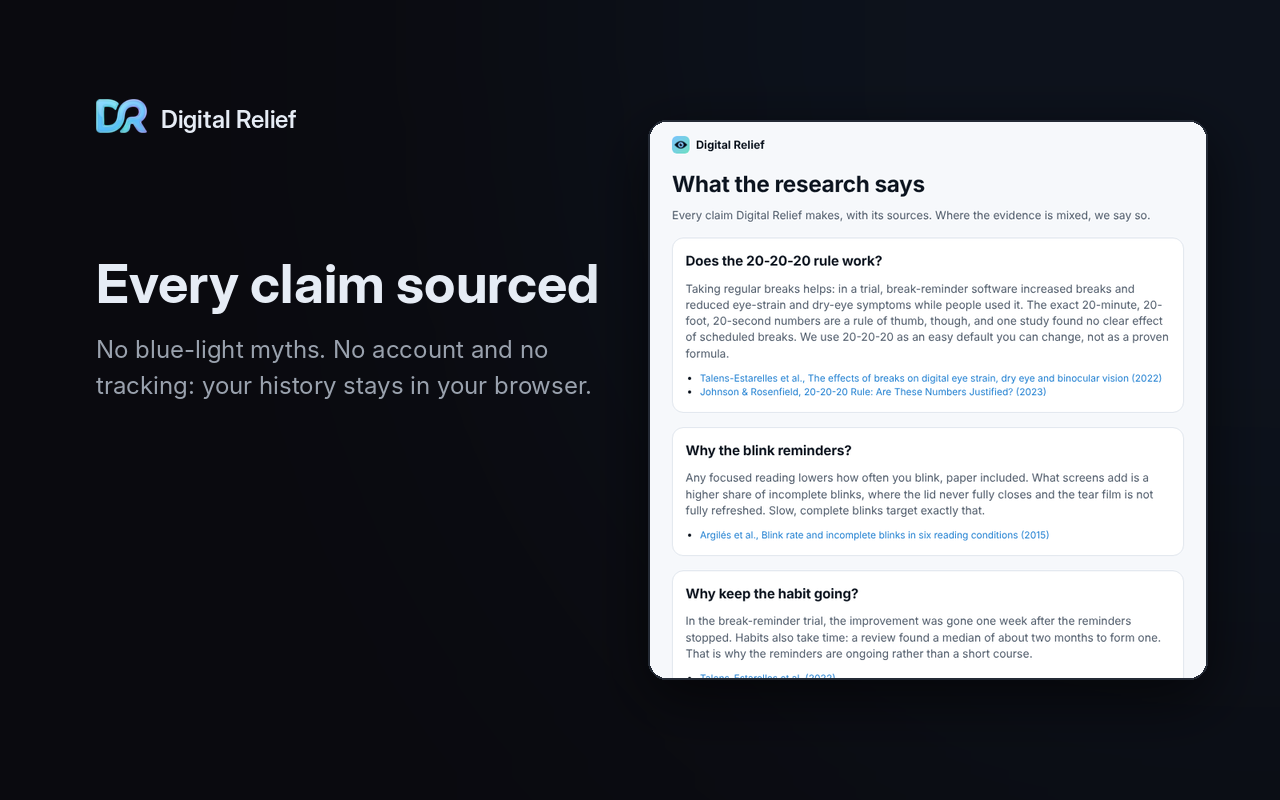
- Looking at one near distance for a long time. The idea behind the 20-20-20 rule is that looking far away gives your eyes a change from close focus. The evidence on breaks is real but mixed, which we cover in Does the 20-20-20 rule actually work?
- Blinking less completely. Reading on a screen raises the share of blinks where the lid doesn't fully close. We explain that study in It's not how often you blink, it's how completely.
Neither of those is about colour. Both are about how you use the screen.
What to do instead
Here's what we'd suggest, in plain terms, based on these sources:
- Take regular breaks, and keep taking them. Look away from the screen at something far off. Digital Relief reminds you after 20 minutes of active screen time, and you can change that.
- Look at your setup. Poor ergonomics were linked to more symptoms. If your screen, chair or desk feel awkward, that's worth fixing. Our guide to monitor settings is a starting point.
- Notice your hours. Long daily screen time was linked to more symptoms. Breaks won't change your total hours, but they break them up.
- Blink fully now and then. A few slow, complete blinks are an easy habit. The extension mixes them into some breaks.
- For sleep, try the phone-down hour. The one trial we cited found no benefit from Night Shift, and an exploratory hint that no phone at all was better for people already sleeping enough.
And if your eyes hurt, your vision changes, or the discomfort keeps coming back, see an eye-care professional. A browser extension can't tell you what's going on.
Why we'd rather ship less
Adding a blue-light filter would have been easy. It would also have looked good on a feature list.
But our whole approach is to make only claims we can back with sources, and to say so when the evidence is mixed. A filter would have quietly implied a benefit that the best reviews don't support.
If strong trials ever show that a software tint eases eye strain, we'll read them and reconsider. Until then, the extension spends its effort on the thing it can actually help with: reminding you to look away.
Make the breaks automatic
Digital Relief is a free Chrome extension that nudges you to look away after 20 minutes of active screen time. No account, no tracking.
Add to Chrome, it's freeEducational only, not medical advice. See an eye-care professional for persistent or severe symptoms.
Sources
- Mataftsi A, Seliniotaki AK, Moutzouri S, Prousali E, Darusman KR, Adio AO, Haidich AB, Nischal KK. Digital eye strain in young screen users: a systematic review. Preventive Medicine, 2023.
- Singh S, Keller PR, Busija L, McMillan P, Makrai E, Lawrenson JG, Hull CC, Downie LE. Blue-light filtering spectacle lenses for visual performance, sleep, and macular health in adults. Cochrane Database of Systematic Reviews, 2023.
- Duraccio KM, Zaugg KK, Blackburn RC, Jensen CD. Does iPhone night shift mitigate negative effects of smartphone use on sleep outcomes in emerging adults? Sleep Health, 2021.
Related reading
Does the 20-20-20 Rule Actually Work?
Break reminders eased eye-strain symptoms while people used them, then the benefit faded. The exact 20/20/20 numbers have little direct support. Here's the evidence.
Eye Strain for Students: Study on Screens Without the Ache
Why long study sessions and screen-heavy schoolwork strain student eyes, and practical fixes — a study-block break schedule, laptop and tablet setup, lighting, sleep, and outdoor time.
Eye Strain for Programmers: Code All Day Without Wrecking Your Eyes
Why long coding sessions are especially hard on your eyes, and practical fixes — breaks that don't break flow, monitor and contrast setup, blinking, and when it's more than just eye strain.