It's Not How Often You Blink, It's How Completely
By Raphael Ben-Hamo, Digital Relief
5 min read · Published October 13, 2026
Reviewed against peer-reviewed research — our standards & sources
You've probably heard that we blink less when we look at screens, and that this is why our eyes feel dry by the end of the day.
That's partly right. But one careful study suggests the more interesting change isn't how often you blink. It's how completely.
This post walks through that study, what it does and doesn't show, and the small blink routine we built into our Chrome extension because of it.
The study
In 2015, a team of researchers filmed people's faces while they read, then analysed the video to measure their blinks (Argilés and colleagues, 2015).
They recruited 50 people aged 18 to 74, all with healthy eyes and no dry-eye symptoms. Each person was recorded in a relaxed baseline condition first: quietly looking at a landscape picture two metres away.
Then they read in six different ways, for six minutes each:
- on a tablet
- on a computer screen at 100% zoom
- on a computer screen zoomed to 330%
- from a book, silently
- from a book, aloud
- from paper text stuck onto a computer screen
That design is what makes the study useful. It compares screens and paper under controlled conditions, with the same people, so you can see which changes come from reading and which come from the screen.
Focused reading lowers blink rate, paper included
The first finding: every reading condition reduced how often people blinked, compared with the relaxed baseline. That held for the book as well as the screens.
The smallest drop came from reading on the computer zoomed to 330%, where the text was very large.
The authors linked the drop to the high mental demand of reading, regardless of what you're reading on. In other words, concentrating on text seems to slow your blinking down. Screens aren't uniquely to blame for that part.
What screens add: incomplete blinks
The second finding is the one that matters for screen users.
An incomplete blink is one where the upper lid starts to come down but doesn't close all the way before opening again.
In this study, the share of blinks that were incomplete went up when people read on a screen. It didn't go up when they read from paper.
The authors suggested that this rise in incomplete blinks may account for the symptoms that screen users report. That's a careful "may". The study measured blinks, not symptoms. Its participants had no dry-eye symptoms, and each session lasted six minutes.
Why completeness might matter
A common explanation, which this study did not test directly, goes like this. Each blink spreads a fresh layer of tears across the front of the eye. When the lid stops short, part of that surface may get refreshed less, and over a long session the eye can feel drier and more tired.
We think that explanation is reasonable, and it fits what the study found. But it's worth being clear that it is an explanation, not a measurement from this paper.
So the useful takeaway is narrow and practical. When you read on a screen, you probably blink less often, as you would with a book. You may also blink less completely, which you wouldn't with a book. The second one is the habit a break can nudge.
The five-slow-blinks routine
Digital Relief, our Chrome extension, mixes a short blink routine into some of your breaks. Instead of the usual "look far away" prompt, the break card asks you to:
- Close your eyes fully.
- Pause for a second.
- Open them again.
- Repeat five times.
It's on by default, under "Blink and stretch breaks" in settings. The same switch also adds an hourly stand-up. You can turn it off if you only want look-far breaks.
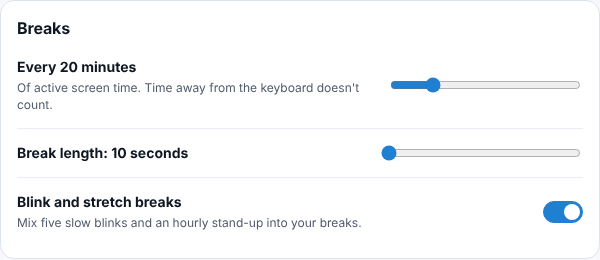
We want to be straight about what this routine is. No study has tested this exact routine, and we don't claim it treats dry eye. Five is a convenient number, not a researched dose.
What it does is aim at the one thing the study showed screens change: the completeness of your blinks. A few deliberate, full blinks take about ten seconds and cost nothing. That felt like a reasonable thing to ask for during a break you were taking anyway.
Trying it without the extension
You don't need software for this. A few times a day, try it on your own:
- Close your eyes all the way, gently, without squeezing.
- Hold for a second.
- Open slowly.
- Do it five times, then go back to work.
If it helps you remember, attach it to something you already do, such as starting a new task or waiting for a page to load.
When to see an eye-care professional
Blink routines and breaks are about comfort during screen work. They aren't a diagnosis or a treatment.
Book an appointment with an optometrist or ophthalmologist if you notice:
- eye pain, or a red, sore eye
- changes in your vision, such as blurring that doesn't clear when you blink
- dryness, grittiness or burning that keeps coming back despite regular breaks
- symptoms that get worse rather than better over time
Dry, uncomfortable eyes can have several causes, and some need proper care. An eye-care professional can tell you what's actually going on.
The short version
- Concentrated reading lowers blink rate on paper and on screens alike.
- Reading on a screen also raised the share of incomplete blinks, at least in this study.
- That rise may help explain screen discomfort, but the study didn't measure symptoms directly.
- A few slow, complete blinks during a break are an easy, low-cost habit. We built them into Digital Relief for that reason, not because they're proven to fix anything.
If you want the bigger picture on breaks themselves, read Does the 20-20-20 rule actually work?
Make the breaks automatic
Digital Relief is a free Chrome extension that nudges you to look away after 20 minutes of active screen time. No account, no tracking.
Add to Chrome, it's freeEducational only, not medical advice. See an eye-care professional for persistent or severe symptoms.
Sources
Related reading
Eye Drops for Screen Dryness: What Actually Helps
Preservative-free lubricating drops can ease screen-related dryness — here's how they fit alongside blinking and breaks, not instead of them.
Blink Exercises for Dry, Tired Eyes at the Screen
Screens cut how often and how completely you blink, which dries out your eyes. Here's a simple blink exercise and habit to build back in.
Gaming and Eye Strain: How to Play Longer Comfortably
Long gaming sessions are tough on the eyes. Here's why, plus practical, evidence-based habits to reduce eye strain without ruining your game.