Does the 20-20-20 Rule Actually Work?
By Raphael Ben-Hamo, Digital Relief
6 min read · Published October 13, 2026
Reviewed against peer-reviewed research — our standards & sources
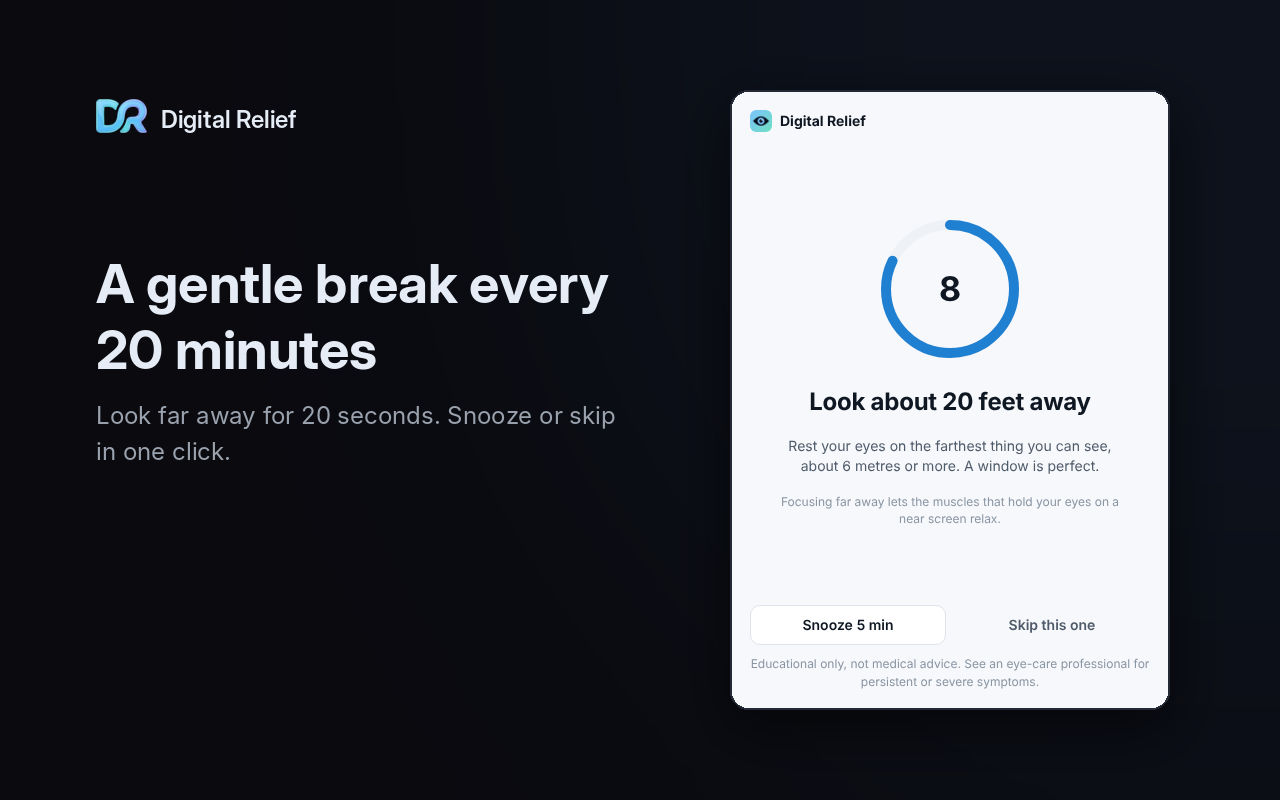
The 20-20-20 rule is simple: every 20 minutes, look at something about 20 feet (6 metres) away for 20 seconds.
It's also the default in our Chrome extension, Digital Relief. That means we owe you a straight answer to the obvious question. Does it actually work?
The short version: taking regular breaks seems to help how your eyes feel, for as long as you keep taking them. The three 20s are a convenient default, not a tested formula.
Here's what the research says, and where it runs out.
Where the rule comes from
The 20-20-20 rule is advice, not the result of an experiment. Clinicians frequently recommend regular breaks for digital eye strain, the tired, dry, uncomfortable feeling many people get after long stretches at a screen, and 20-20-20 is a widely cited version of that advice.
It's easy to remember, which is a big part of its appeal. But when two researchers tested it in a 2023 paper, they noted that there is "relatively little peer-reviewed evidence" behind it (Johnson and Rosenfield, 2023).
So the honest starting point is this: the rule is popular because it's practical, not because a trial picked those numbers.
What happened when people got break reminders
The most direct test we know of comes from a 2023 study in Contact Lens and Anterior Eye (Talens-Estarelles and colleagues).
Twenty-nine computer users who already had symptoms installed software on their laptops. It used the webcam to track breaks, gaze and blinking, and sent personalised break reminders based on the 20-20-20 rule. They used it for two weeks.
Three things changed:
- People took more breaks. The number of breaks per day went up and time spent on computer work went down, though each break was shorter.
- Symptoms went down. Scores for digital eye strain and dry-eye symptoms improved on standard questionnaires.
- The eye itself didn't measurably change. Tests of the tear film and eye surface showed no change, and most binocular vision measures stayed the same over two weeks. One focusing measure, accommodative facility, did improve.
That's a meaningful result, with real limits. It was a small group. Everyone in it got the reminders, and the comparison was before, during and after, not against a separate group without reminders. And the gains were in how people felt, not in clinical signs.
The benefit didn't last
The same study checked again one week after the reminders were switched off. The improvement in symptoms was no longer there.
This is the finding that shaped our extension more than any other. It suggests the reminders weren't a course of treatment that fixed something. The benefit came from the breaks themselves, and it faded when the breaks stopped.
Put simply: breaks seem to help while you keep taking them.
The specific numbers lack direct support
The other 2023 study asked a narrower question: are the 20s themselves justified? (Johnson and Rosenfield)
Thirty young participants did a demanding 40-minute reading task on a tablet, on four separate occasions. Each time, they were allowed a 20-second break every 5, 10 or 20 minutes, or no break at all.
Symptoms went up after every session. But the break schedule made no significant difference to symptoms, reading speed or accuracy. The authors concluded that their results don't support 20-second scheduled breaks as a treatment for digital eye strain.
That study has limits too. It was a single 40-minute session in a lab, not a working day. It only tested 20-second breaks, not longer ones. So it doesn't show that breaks are useless. It shows that the exact 20-second dose doesn't have direct evidence behind it.
So, does it work?
The two studies point in different directions, and they were asking different questions in different settings.
One followed people with symptoms through two weeks of their real work, and found that reminders helped them take more breaks and feel better. The other tested short breaks during a single lab session, and found no effect.
A fair reading of both:
- Regular breaks may help how your eyes feel, especially over days of real use.
- The help seems to depend on keeping the habit going.
- Nobody has shown that 20 minutes, 20 feet and 20 seconds are the right numbers.
That's why we treat 20-20-20 as an easy default, not a prescription.
How we use it in Digital Relief
The extension starts at 20 minutes and 20 seconds, because the rule is familiar and easy to follow. You can change both: the interval runs from 10 to 60 minutes, and the break from 10 to 60 seconds.
It counts only active screen time. If you step away or lock your screen, the timer pauses, and five or more minutes away counts as a break you've already taken.
Most of the design goes into the part the research says matters: keeping the habit going without it becoming annoying. That means meeting mode, snooze, and a quiet reminder style when you don't want a card on screen.
Habits take longer than a few days
If the benefit fades when the breaks stop, the real goal is a habit that sticks. That takes time.
A 2024 review pulled together 20 studies of 2,601 people forming health habits like flossing, drinking water and being more active (Singh and colleagues). In the four studies that reported it, the median time to form a habit was 59 to 66 days. Individual times ranged from 4 days to 335.
Two caveats. None of those studies looked at screen breaks. And the authors rated most of the studies at high risk of bias. Still, the message is useful: expect weeks to months, not days. That's why Digital Relief's reminders keep running rather than stopping after a short course.
Keeping the habit off the desk
Chrome can only see the time you spend in Chrome. Your phone is a different story.
If you want the same habit on your iPhone, EyeReset is our app for that. It adds guided eye breaks and reminders for the screen time your browser can't see.
When a break isn't enough
Breaks are about comfort during screen work. They aren't a treatment for any eye condition.
If you have eye pain, changes in your vision, or symptoms that keep coming back despite regular breaks, book a visit with an eye-care professional.
Make the breaks automatic
Digital Relief is a free Chrome extension that nudges you to look away after 20 minutes of active screen time. No account, no tracking.
Add to Chrome, it's freeEducational only, not medical advice. See an eye-care professional for persistent or severe symptoms.
Sources
- Talens-Estarelles C, Cerviño A, García-Lázaro S, Fogelton A, Sheppard A, Wolffsohn JS. The effects of breaks on digital eye strain, dry eye and binocular vision: testing the 20-20-20 rule. Contact Lens and Anterior Eye, 2023.
- Johnson S, Rosenfield M. 20-20-20 Rule: Are These Numbers Justified? Optometry and Vision Science, 2023.
- Singh B, Murphy A, Maher C, Smith AE. Time to Form a Habit: A Systematic Review and Meta-Analysis of Health Behaviour Habit Formation and Its Determinants. Healthcare, 2024.
Related reading
Why Our Extension Has No Blue-Light Filter
Do blue-light filters help eye strain? Two reviews found little sign they do, and a night-mode trial found no sleep difference. Here's what we built instead.
Eye Strain for Students: Study on Screens Without the Ache
Why long study sessions and screen-heavy schoolwork strain student eyes, and practical fixes — a study-block break schedule, laptop and tablet setup, lighting, sleep, and outdoor time.
Eye Strain for Programmers: Code All Day Without Wrecking Your Eyes
Why long coding sessions are especially hard on your eyes, and practical fixes — breaks that don't break flow, monitor and contrast setup, blinking, and when it's more than just eye strain.